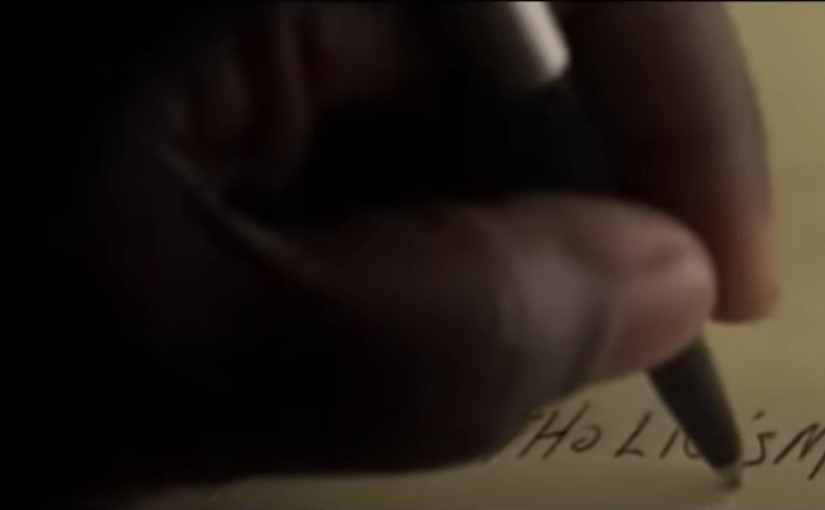
What humans are capable of is far more terrifying than a ghost or even a demon. Fincher’s villain in Se7en, unnamed, unseen, unnamed in the trailer, the opening credits, or in either of Roger Ebert’s pieces about the film (he liked it more as time went on) displays this terror as well as any film villain – supernatural or otherwise.

As the sun set the day after one of the most horrific days of my life, it was quiet and I put on my headphones to watch a movie that I knew would, through horror, distract me from my own. And in the first 30 minutes, you see Somerset’s Black Parker Jotter 10 times. His switchblade once, his gun once, his badge once… His work is not in shooting or intimidating, it is investigation, though he receives mostly grief for it. The beat cop who shows him into an apartment at the beginning of the film, unconnected to the Se7en murders, “you know we’re all gonna be glad when you’re retired Somerset!” The question, “Did the kid see it?” Somerset attempts to bring pause, a string, a shred of decency into this soaking wet, murderous, nihilistic place. Fincher’s setting for the film is not NYC (though that’s the library). It is not LA (the diner that you’ve seen before). It is Hell.
The others will see him – Mills listens to Somerset, the chief references “his big brain”, the guard at the library accommodates him with classical music, and Tracy sees him — and pays for it. The culture wins again, malice defeats nobility; utterly.
Somerset’s fatigue is immense as he climbs into the cab. This is one of the few moments in the city when it is not raining. The weight upon his eyes only increases as they drive by another unconnected murder. At the library he gives the definitive speech about his character and how it conflicts and contrasts with this horrific realm (copied most recently by Matt Reeves in The Batman), “Gentlemen, gentlemen, a wealth of knowledge and culture is at your fingertips, and what do you do? You play poker.” “We’ve got culture, culture coming out of our ass!” More of the villain’s assessment is correct than we are comfortable with. Said without the venom of the beat cop, and gently softened by the guard who let him into the library, “how about this for culture?” as he plays Bach’s Air Suite #3. This guard and Tracy are the only ones who appreciate Somerset’s gentle, but clear defiance of Hell. Even as Somerset knows he will lose battle after battle, and ultimately the war.
Even in Hell, at least for Fincher, there can be grace and beauty. Worth a brief rewatch: The library scene is exquisite.
 Jotter in Film